
A Repeatable Product Hunt Workflow for Finding Search Demand
A Repeatable Product Hunt Workflow for Finding Search Demand
The goal of this workflow is not to clone a Product Hunt launch. It is to find a user task that already sends non-brand search traffic to a young domain—and then decide whether that signal is durable enough to validate.
Product Hunt supplies a fresh candidate list. AITDK or Traffic.cv supplies estimated domain age, visits, channels, and visible keywords. First-party pages explain the job. Search results, communities, competitors, and Google Trends test whether the job exists beyond launch week.
OpenLogi is a useful example because it passes the traffic screen and exposes a clear non-brand task, yet the final decision is still Validate / Observe, not Build. The problem is real; the available evidence does not establish a large search market.
The decision pipeline
Product Hunt launch archive
→ resolve the product's real root domain
→ screen domain age, visits, Search, and Direct
→ remove brand keywords
→ translate remaining queries into a user job
→ cross-check SERPs, communities, and alternatives
→ compare long and short Google Trends windows
→ Build / Validate / Observe / Reject
Every step has a limited purpose. Estimated traffic ranks candidates; it does not prove revenue. A landing page explains positioning; it does not prove keyword volume. A forum thread proves that somebody has the problem; it does not size the market.
1. Start with launches, not winners
Open Product Hunt Launches for a specific date and collect websites from across the list. Upvotes and daily rank measure launch performance, not search demand.
On August 23, 2026, OpenLogi ranked fourth. Its Product Hunt page describes a local-first alternative to Logitech Options+ and links to openlogi.org.
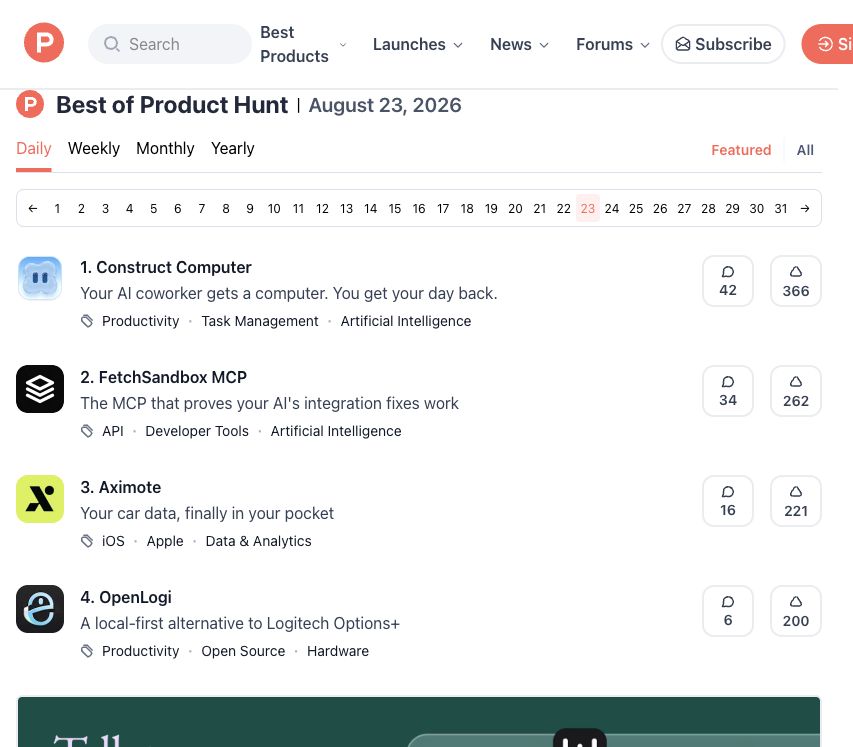
Record the chain explicitly:
Product page: https://www.producthunt.com/products/openlogi
Official site: https://openlogi.org/
Root domain for analysis: openlogi.org
An App Store, browser-extension store, GitHub repository, or shared hosting subdomain may represent a legitimate product, but it cannot demonstrate the same “young independent domain won SEO traffic” pattern. Also check RDAP or WHOIS; a Product Hunt launch date is not a domain registration date.
2. Apply one hard screen to every candidate
The working filter used in this research was:
domain age ≤ 1 year
estimated monthly visits ≥ 3,000
Search share ≥ 20%
Direct share ≥ 20%
AITDK's snapshot for OpenLogi showed the following values.
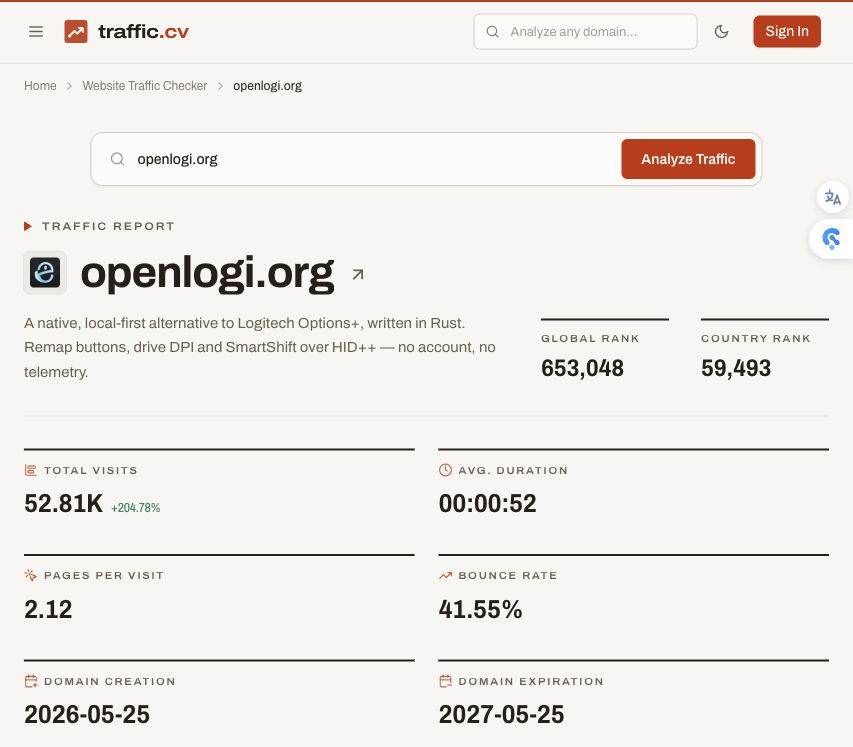
| Metric | Observed value | Gate |
|---|---|---|
| Domain creation date | 2026-05-25 | Under one year |
| Domain age | 98 days | Pass |
| Monthly visits | 52.81K | Above 3,000 |
| Recent growth | +204.78% | Context only |
RDAP reports 2026-05-24T16:07:15Z; that becomes May 25 in China and Japan. The apparent one-day mismatch is a timezone display difference.
The same snapshot attributed 53.78% to Search and 26.45% to Direct.
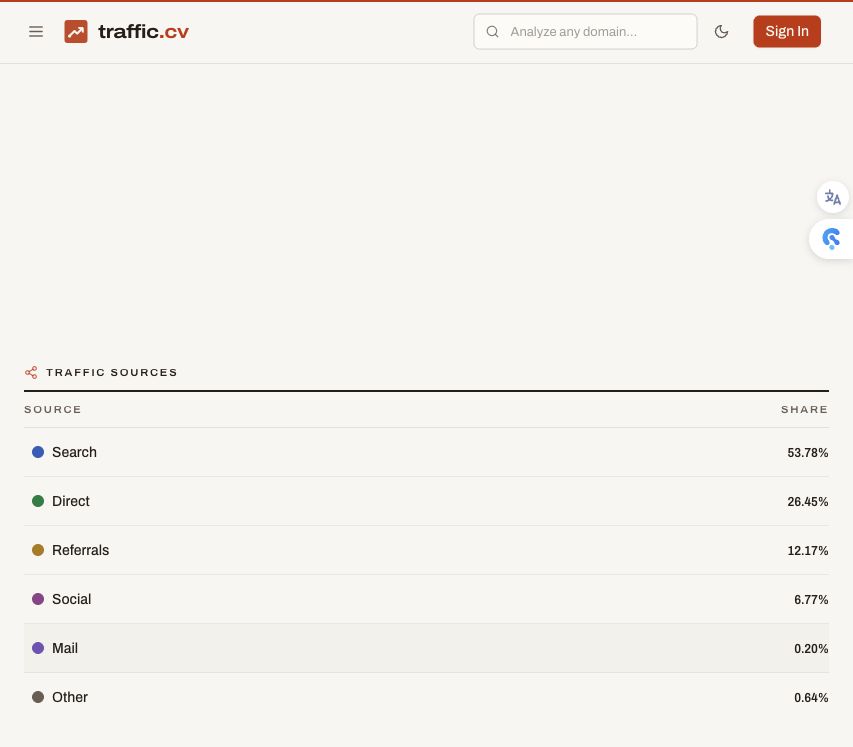
| Channel | Observed share | Gate |
|---|---|---|
| Search | 53.78% | ≥20% |
| Direct | 26.45% | ≥20% |
These are third-party estimates, not analytics exports. Search above 20% makes keyword inspection worthwhile. Direct above 20% suggests the site is not wholly dependent on one attributed referral source, but it is not a retention rate; it also includes typed URLs, bookmarks, and unattributed sessions. Missing data is unknown, never an automatic pass.
3. Expect most candidates to fail
This batch started with 38 Product Hunt products. Thirty-two had independently queryable domains; only three cleared all four numerical gates in the captured dataset.
| Site | Domain age | Monthly visits | Direct | Search |
|---|---|---|---|---|
omlx.ai | 339 days | 127.47K | 42.64% | 42.12% |
openseo.so | 167 days | 138.71K | 50.60% | 21.30% |
openlogi.org | 98 days | 52.81K | 26.45% | 53.78% |
The table is a research snapshot, not verified first-party measurement. Its job is to reduce thirty-two domains to three research candidates. A strict filter is useful precisely because it produces a small list.
4. Separate product discovery from task discovery
After the numerical gate, inspect visible search keywords.
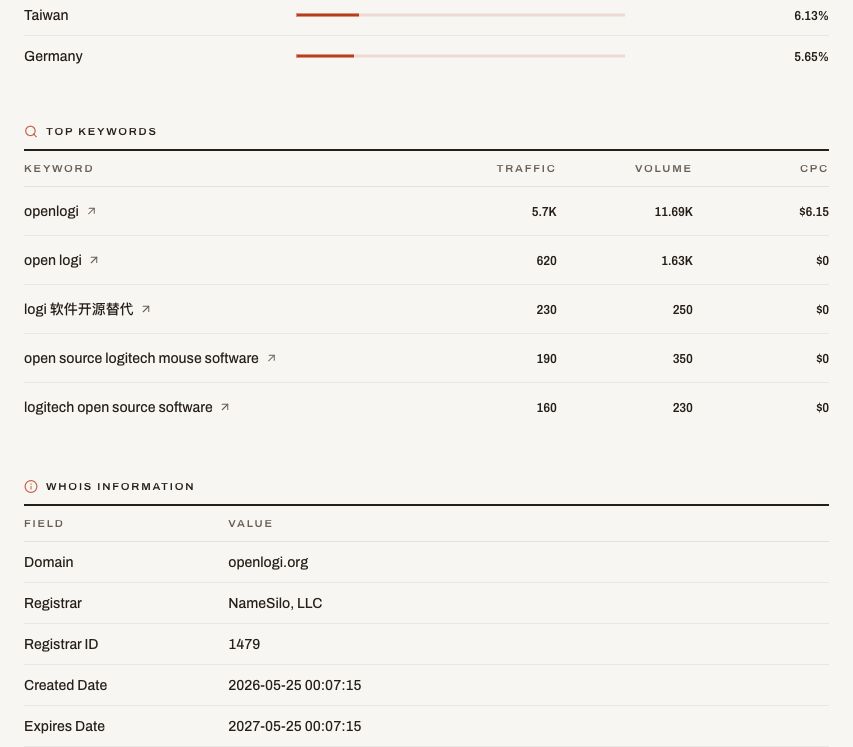
OpenLogi's snapshot contains brand terms such as openlogi and open logi, plus non-brand phrases including open source logitech mouse software and logitech open source software.
Brand searches show that people know the product. They do not reveal a product-independent opportunity. A non-brand task can survive if the product disappears: Logitech users may still look for open-source configuration software.
The other two numerical winners were weaker at this stage. Their visible top terms were largely brand variations or product-specific lookups. They belong in Observe until a real non-brand query appears.
Do not manufacture a keyword from website copy. A feature page can interpret an observed query; only a keyword or query source can prove the exact phrase was observed. Anything inferred belongs under hypothesis.
5. Use the official site to identify the job
The OpenLogi official site currently describes a native, local-first application for button remapping, DPI, and SmartShift, without an account or telemetry. It offers macOS, Linux, and Windows builds and also warns that the product is under active development.
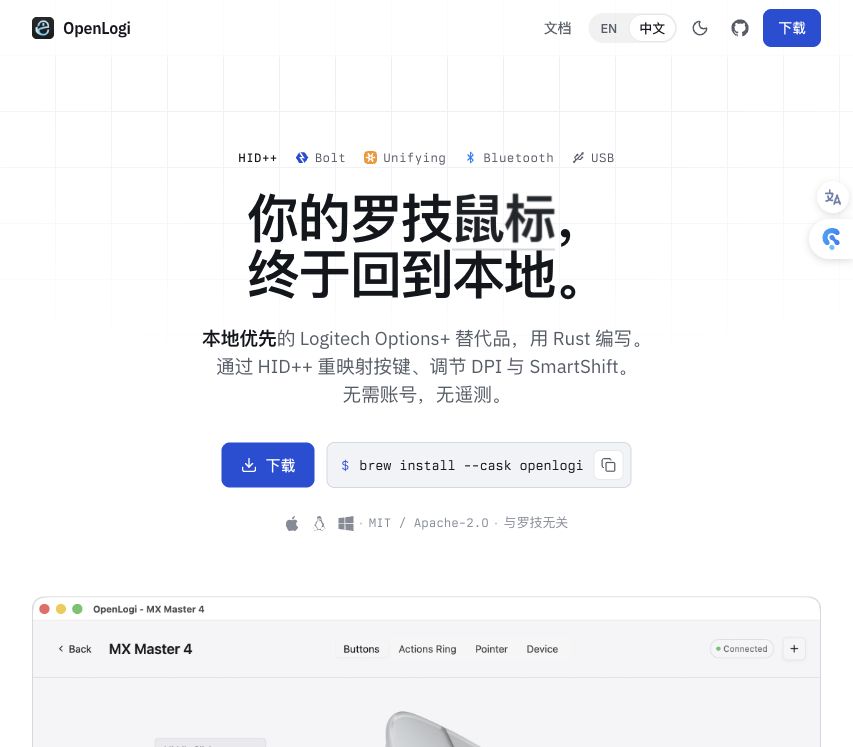
The user job can now be written without copying the product:
Logitech peripheral owners who do not want an account, cloud dependency, or telemetry need to remap controls and manage device settings locally on their operating system.
This is interpretation, not new volume evidence. The official page helps explain why a query exists; it cannot tell us how many people make that query.
6. Check whether the problem predates the launch
Search the exact observed phrase and a broader unquoted version:
"open source logitech mouse software"
open source logitech mouse software
The exact wording has little stable coverage. Broader results expose OpenLogi, GitHub repositories, Reddit and Hacker News discussions, Logitech's official software, and alternatives such as Mouser and Solaar.
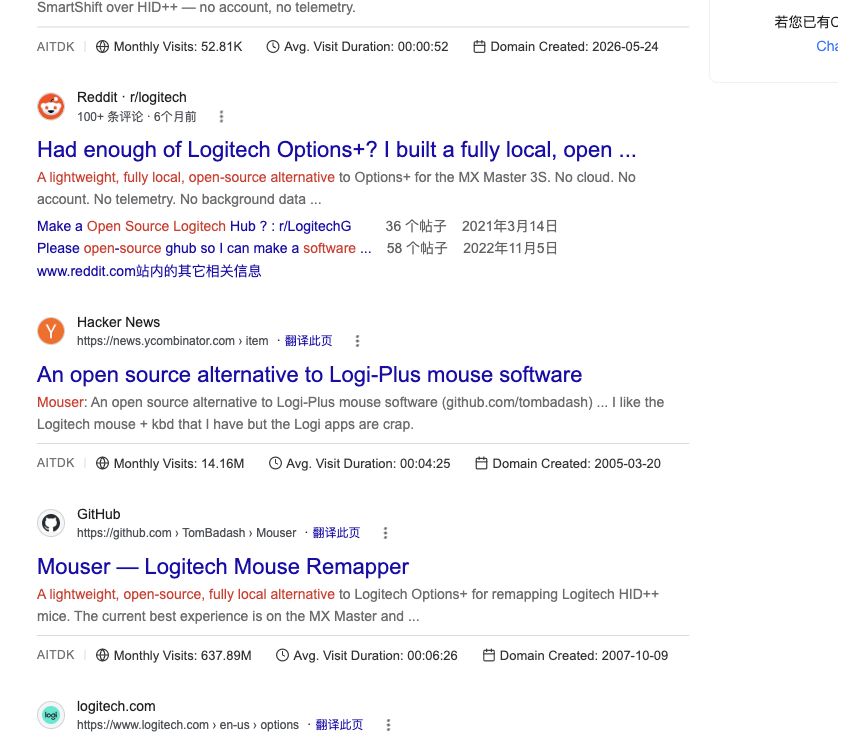
Independent alternatives and discussions from different dates show that the underlying job did not begin with OpenLogi's launch. User complaints are still personal reports, not factual findings about Logitech's performance, privacy practices, or liability.
At this gate, look for repetition across sources, discussions that predate launch day, multiple attempts to solve the job, concrete user losses, and a SERP that is not completely occupied by mature authoritative products.
7. Let trend shape the decision
Compare an observed phrase with a more natural category phrase:
open source logitech mouse software
logitech options alternative
Review five years, twelve months, ninety days, thirty days, and seven days. In the captured research, the exact phrase was near zero for most of the five-year window and moved around the August 2026 launch. The broader alternative phrase was also sparse.
Low-volume Google Trends data can be zero even when searches exist. AITDK separately estimated roughly 230–350 monthly searches for related terms. Neither source is sufficient on its own. Together they support a narrow conclusion:
- the configuration problem exists;
- launch activity probably amplified recent interest;
- the exact search market looks small;
- the next state is
Validate / Observe, not a full build.
Validate the smallest wedge next
Before building a driver or a large content site, map four dimensions: device model, operating system, must-have action, and the gap in existing alternatives. Then verify natural combinations—model plus alternative, Linux, or button remap—with Keyword Planner, Ahrefs, Semrush, or first-party query data.
Move to keyword-difficulty and return-on-effort analysis only after several non-brand queries, durable trend evidence, a specific unmet capability, and acceptable implementation cost appear together.
Daily operating checklist
- Collect real root domains from one Product Hunt date.
- Verify domain age independently of launch date.
- Apply the same traffic gates; mark missing data unknown.
- Remove brand terms and preserve exact observed task queries.
- Use first-party pages to interpret the job, not invent keywords.
- Cross-check SERPs, communities, and competing solutions.
- Compare long and short trend windows.
- Record one explicit state:
Build,Validate,Observe, orReject.
Pages and data were observed on 2026-08-31. Product Hunt rank and current OpenLogi behavior were checked against first-party pages. AITDK/Traffic.cv visits, channel shares, keywords, and search volume are third-party estimates from the captured research and may change with time or methodology.
Latest from the blog
New research, comparisons, and workflow tips from the Vibe Coding Tools team.
A recorded Muse signup through Airtap, covering email codes, birthday confirmation, Meta account creation, and the limits of the invite-code and chat checks.
A practical look at local LLMs and agent workflows on a 32GB Apple Silicon Mac mini, including Qwen3.6-35B-A3B, MLX, and tool-calling limits.
A practical review of Jev's typed decisions, state handling, current AI Gateway availability, and independent open source alternatives.