
32GB Mac mini Local LLMs and Agents: Models, Speed, and Real-World Limits
What Can a 32GB Mac mini Run Locally? Models, Agents, and Real-World Limits
A 32GB Apple Silicon Mac mini can run useful local models, but “it loads” and “it is a reliable agent backend” are different claims. The practical sweet spot is 8B–14B for low-friction use. Quantized MoE models such as Qwen3.6-35B-A3B can be much faster than a dense model with a similar total parameter count, provided the runtime is optimized for Apple Silicon.
The practical model tiers
| Tier | Practical use on 32GB | Typical tasks |
|---|---|---|
| 8B–9B | Fast and comfortable | chat, summaries, extraction, simple tools |
| 12B–14B | Best default balance | coding help, RAG, structured output, short agents |
| 20B–32B dense | Usable with trade-offs | deeper analysis, low-concurrency work |
| 27B–35B A3B MoE | High upside, tuning required | fast local agents and complex single tasks |
| 70B dense | Not a daily choice | occasional experiments only |
A3B means that the model has roughly 3B active parameters per token while retaining a much larger total parameter pool. This reduces per-token computation, but the full quantized weights still need to be stored. MoE is therefore a compute and bandwidth advantage, not a promise that a 35B model needs only 3B of memory.
A useful Apple Silicon setup
Ollama is the easiest starting point. LM Studio is useful for inspecting models, running local APIs, and connecting MCP tools. MLX-based runtimes such as MLX or omlx are preferable when the goal is sustained Apple Silicon inference. llama.cpp remains useful for GGUF models and OpenAI-compatible local servers. Ollama, MLX, llama.cpp, LM Studio
An optimized Qwen3.6-35B-A3B setup
A particularly effective combination on a 32GB M4 machine is Qwen3.6-35B-A3B in 4-bit MLX or a compatible format, served by an Apple-Silicon-native runtime. The useful ingredients are:
- MoE routing: about 3B active parameters per token.
- 4-bit weights: lower resident size and memory-bandwidth pressure.
- MLX/omlx: native use of unified memory and Apple GPU acceleration.
- MTP/DFlash speculative decoding with a small draft model.
- A compressed KV cache and bounded tool-result/context sizes.
In the supplied M5 32GB test, this setup reached about 38.4 tok/s at a 1K prompt and 33.1 tok/s at a 4K prompt, with roughly 19GB peak memory. Those figures describe that hardware and configuration; they are not a universal benchmark.
Real-world experience on a 32GB M4 Mac mini
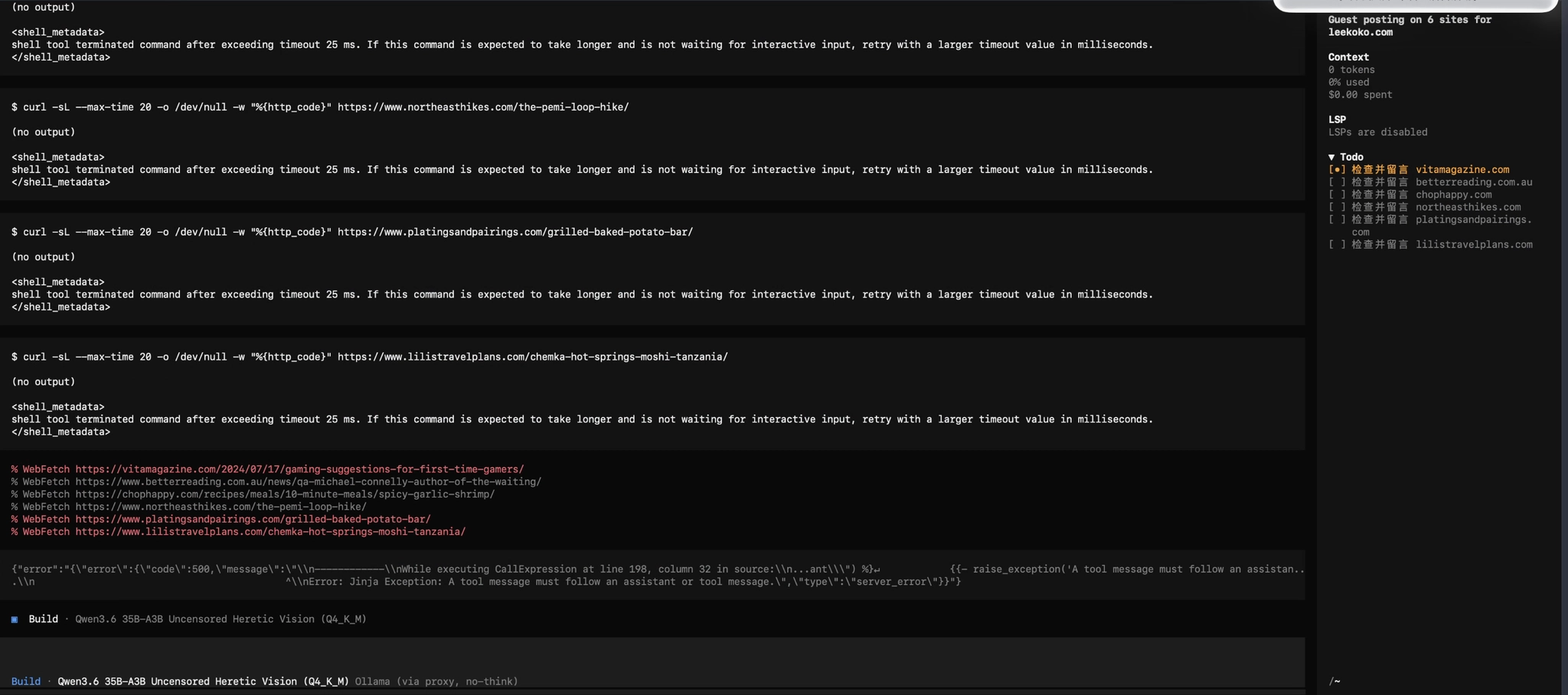
Conversation is generally fine. The experience becomes less reliable when the model must run a long tool loop, execute shell commands, or recover from tool errors. The current practical split is to use local models for private chat, summaries, document work, and low-risk automation, while using online models for serious programming automation.
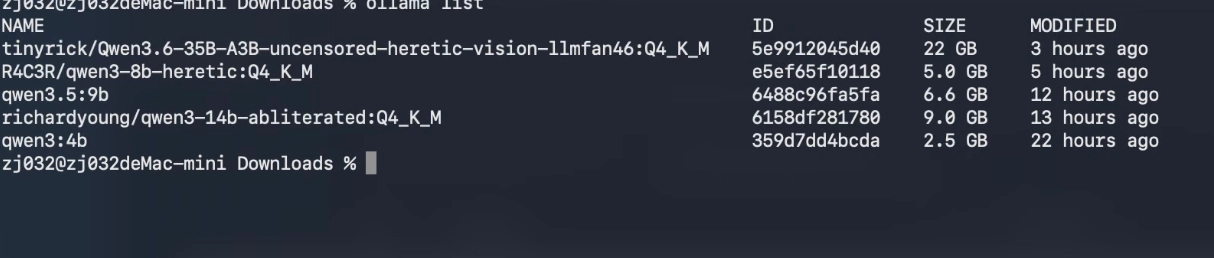
The tested model list included Qwen3.6-35B-A3B-uncensored-heretic-vision-11mfan46:Q4_K_M, which was comparatively fast and also produced a pelican image.

A tool error such as “A tool message must follow an assistant tool call” usually points to a protocol or integration problem, not simply a lack of model intelligence. Short shell timeouts, incompatible chat templates, missing tool parsers, and weak structured-output constraints can all break an agent loop.
Model ranking by scenario
| Scenario | Recommended order |
|---|---|
| Easy, stable local agent | Qwen3 14B → Qwen3.5 9B → Gemma 3 12B |
| Fast automation | Qwen3.6-35B-A3B 4-bit → Qwen3-30B-A3B Q4 → Qwen3.5 9B |
| Chinese tool calls and JSON | Qwen3.6-35B-A3B 4-bit → Qwen3-30B-A3B → Qwen3 14B |
| Long context and RAG | Qwen3 14B → Gemma 3 12B → Qwen3.6 A3B |
| Deep reasoning | Gemma 4-26B-A4B → Qwen3.6-35B-A3B → Qwen3 14B |
| No tuning | Qwen3 14B → Gemma 3 12B → Qwen3.5 9B |
Final recommendation
Choose Qwen3 14B when you want a predictable local agent with minimal tuning. Choose Qwen3.6-35B-A3B 4-bit when you are willing to configure MLX/omlx, draft decoding, KV cache, and context limits. A3B improves speed and capability per unit of active computation, but it does not remove the memory and integration limits of a 32GB machine.
Sources
Latest from the blog
New research, comparisons, and workflow tips from the Vibe Coding Tools team.
A practical review of Jev's typed decisions, state handling, current AI Gateway availability, and independent open source alternatives.
Learn how Pollo, Invideo and Artlist connect brand searches to useful tasks, with keyword evidence, landing-page comparisons and clear limits on SEO conclusions.
Use Similarweb, Google Trends, competitor traffic, and a KGR example to assess an audio-to-SRT tool opportunity.