
Dessa AI Voice Model: Official Demos, Access and Potential Use Cases
AI-generated concept illustration, not a product interface or a benchmark result.
You can listen to Dessa today, but that is different from being able to use the model. As of October 28, 2026, Block's official research page offers recorded conversations. It does not provide a working public chat interface, model download or public API. A limited early-access route is intended for AI safety researchers. Official Dessa page
That distinction matters if you arrived looking for a voice tool for a project. Dessa is interesting for conversational timing: listening while speaking, reacting to an unfinished thought, and using pauses or laughter in context. Those demonstrations suggest possible applications. They do not yet establish a usable narration service, language tutor or voice-agent integration.
Listen to the official recordings
The following is a walkthrough of the recording player, not a live model trial. Listening does not require uploading your voice or enabling your microphone.
1. Open a conversation
Open Talking about the release and locate the two speaker tracks and the play control.
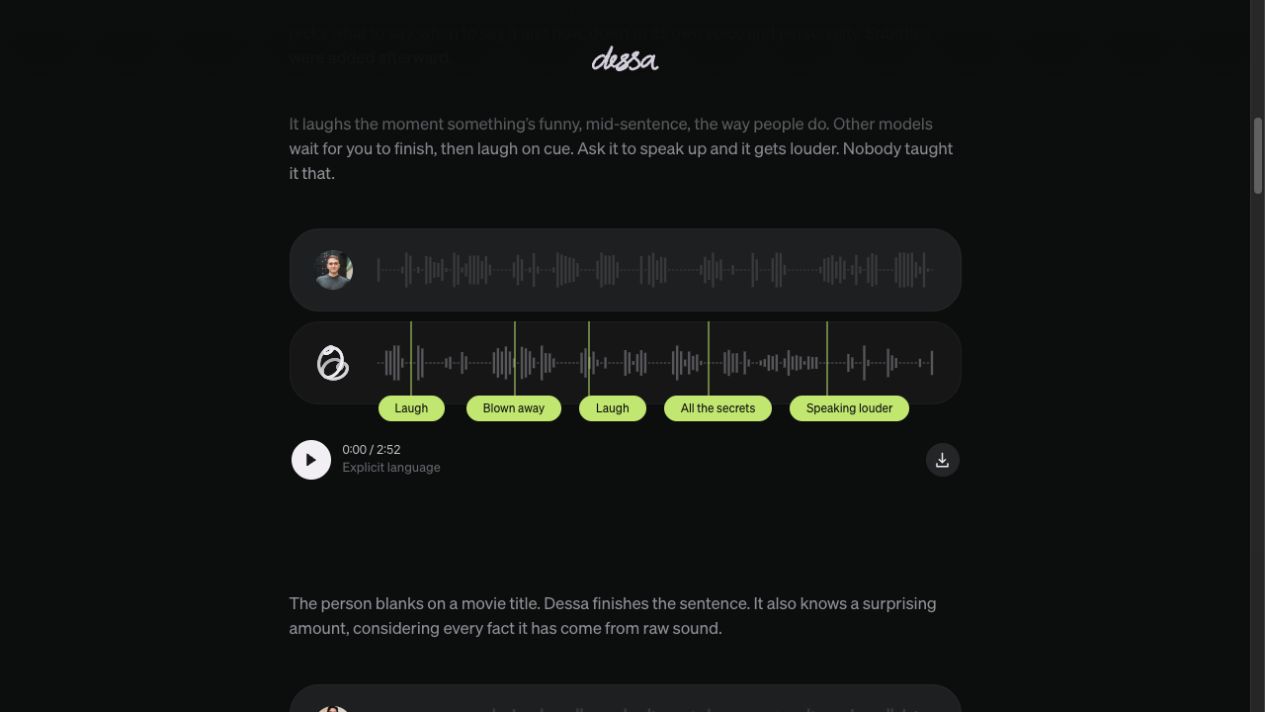
Official Block page, captured October 28, 2026. Interface labels are shown as they appear on the site.
2. Start playback
Select the triangular play button below the tracks. Once playback starts, the same control becomes a pause button.
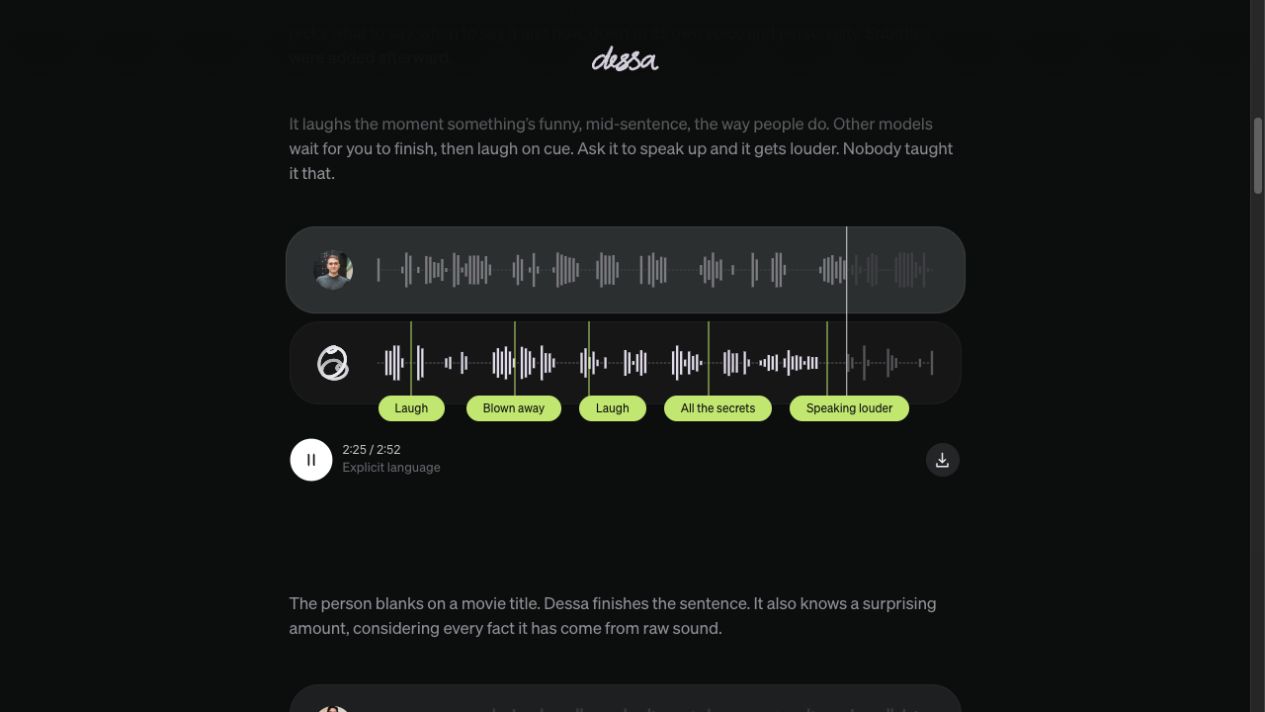
A playback-state example. Automatically transcribed captions are useful for following the exchange, but are not a manually corrected transcript.
3. Jump to a marked moment
Select the green Speaking louder marker to jump to approximately 02:19. The Laugh markers provide other entry points.
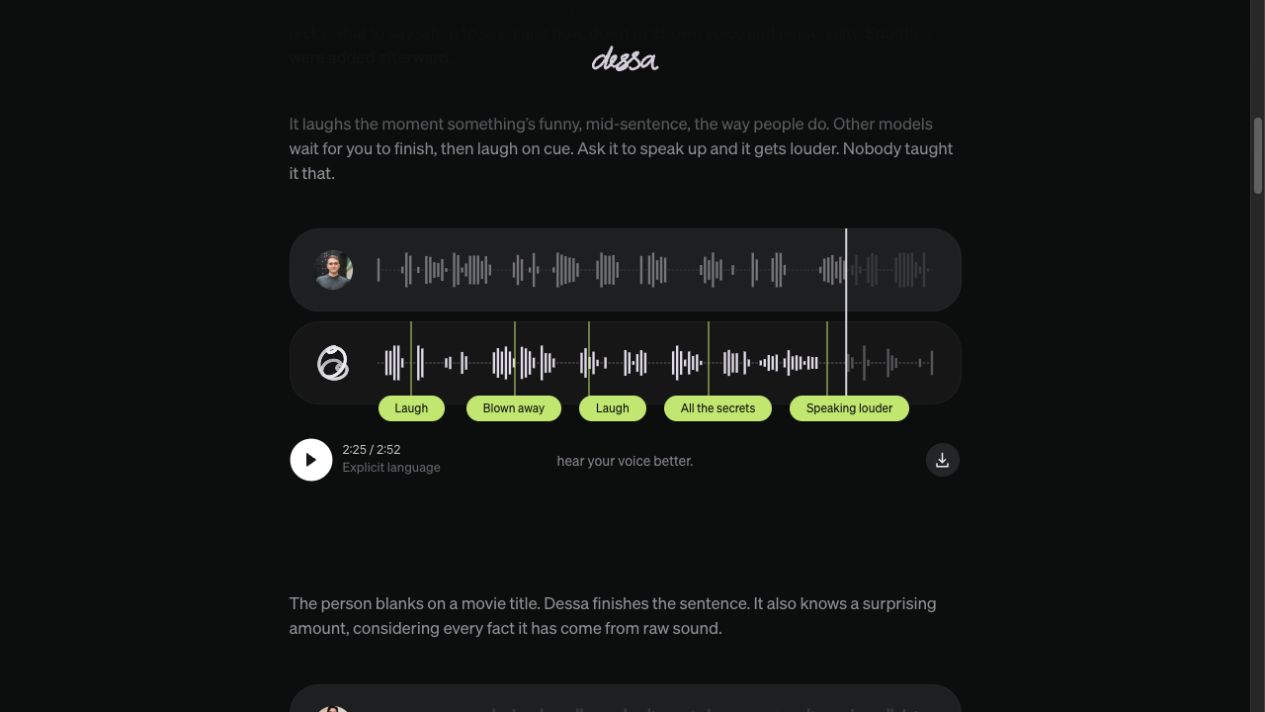
Paused after seeking. The adjacent download control is for a demo clip, not model weights.
Choose a recording around the behavior you want to hear:
| Behavior | Official recording | Marked time |
|---|---|---|
| Laughter and a request to increase volume | Talking about the release | 00:11–00:12; 02:19–02:35 |
| Joining a conversation when someone cannot recall a detail | Remembering a movie | 00:29–00:56 |
| A gasp and a quiet response to a surprise | An anniversary surprise | 00:47–00:48; 01:01–01:05 |
These timestamps are the site's own annotations. Block describes the clips as recordings of people talking to Dessa, with subtitles added afterward. They are selected demonstrations, not an independent test of how consistently the model behaves. Recording notes
Four possible uses for conversational voice
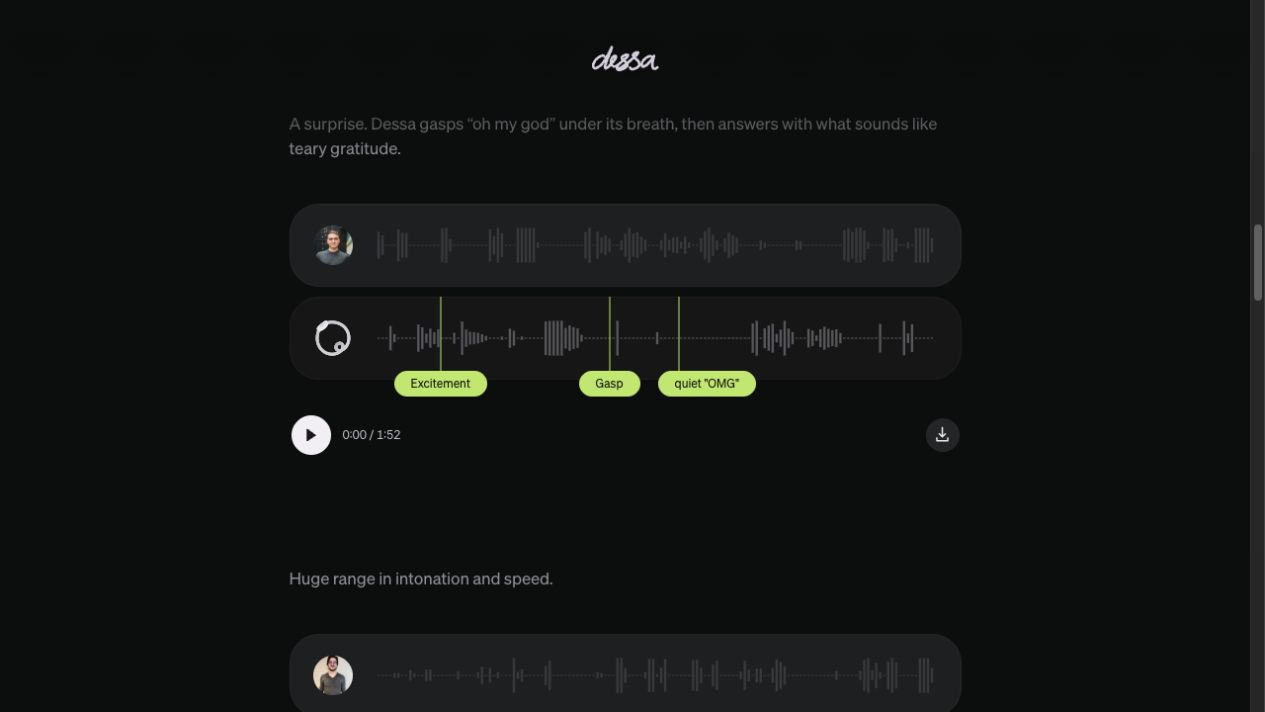
A situational conversation on the official site. It is evidence of a selected demonstration, not an available role-play product. Source
The applications below are hypotheses based on those demonstrations. The sample openings are illustrative conversation scripts for a future interactive release; they were not tested here and cannot currently be entered into the official recording page.
Everyday conversation and companionship
Someone describing an important day may want a short acknowledgment or a follow-up question rather than a long answer. The potential benefit is a conversation that accommodates small shifts in tone and timing. Block's Expressive conversation and Life advice samples provide material to listen to.
A future session might begin with a specific event: “I finally finished the presentation I was worried about. Let me tell you what happened.” That gives the other speaker a topic to follow rather than a vague request to sound friendly.
Users in r/aipartners also discuss their hopes for more lifelike spoken companions. That is a demand signal from a small discussion, not proof of persistent memory or reliable long-term companionship. Community thread
Spoken English practice
Conversational practice involves reformulating a sentence, searching for a word and responding before you have a perfect script. A full-duplex model could make that practice feel less like taking turns with a recorder.
One possible exercise is to describe a weekend in two minutes: “I'd like to practice talking about my weekend. Ask me one question at a time, and give me a moment to answer.” Listen to Remembering a movie for a selected example of conversational assistance when a speaker cannot recall something.
This is not a confirmed tutoring feature. The public materials do not establish pronunciation scoring, grammar correction or a complete language-support list. In particular, do not assume that English recordings establish support for Chinese, Japanese or other languages.
Role-play and rehearsal
An improvised character must respond to the previous line rather than replay a fixed script. The anniversary recording suggests why vocal expression might matter in an interactive story, a customer conversation rehearsal or an interview exercise.
A concrete future opening would be: “Let's role-play a conversation in a bookshop. You're the bookseller, and I'm looking for a mystery novel.” This sets a scene and a goal. Whether Dessa can reliably follow that instruction or maintain a character across a long exchange remains untested. No game plug-in or character editor has been announced on the research page.
Voice assistants and merchant services
Consider a caller saying, “I'd like Friday—actually, Saturday evening.” Handling that correction without forcing the person to restart could improve a voice interaction. Completing a booking or changing an order, however, requires access to a separate business system.
Hacker News readers raise exactly that integration question: how would a speech-only conversation model interact with something outside an audio channel? The suggestions in that thread are not published Dessa features. With no public API documentation, there is currently no documented integration path for calendars, support systems or ordering software. Integration discussion
What access is actually available?
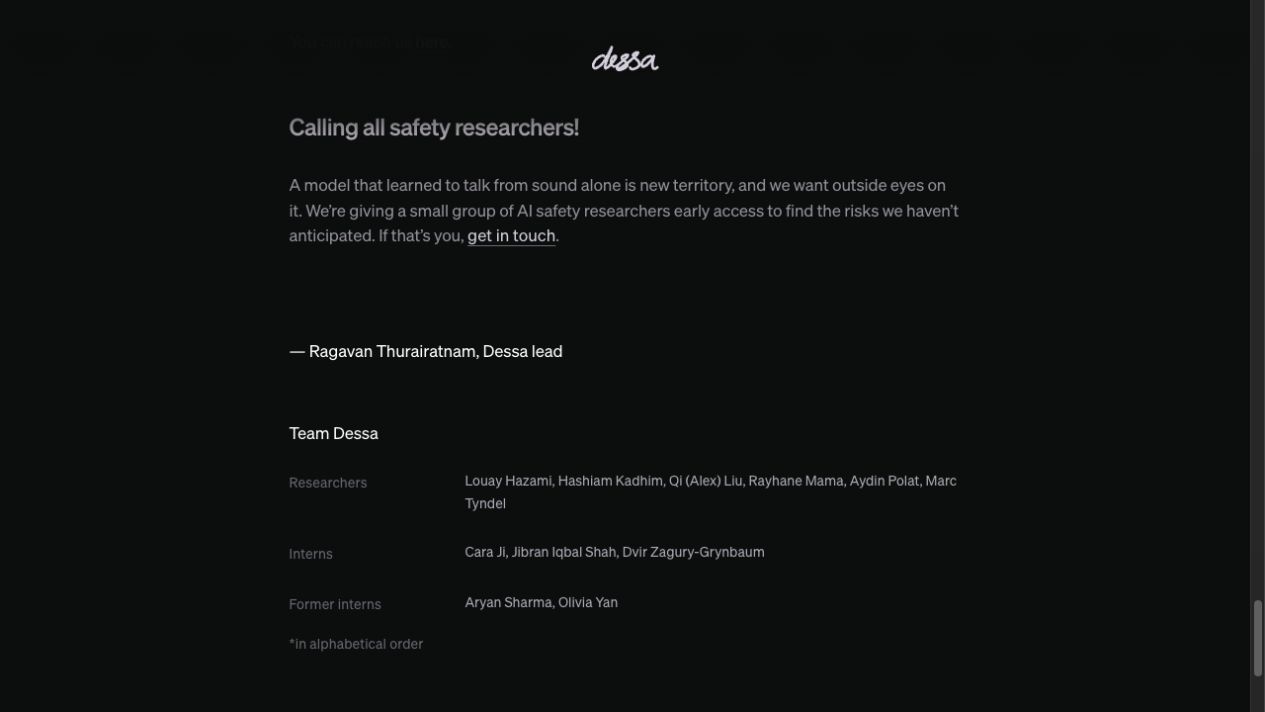
Safety researchers can use the site's get in touch entry point to review contact or application options. This is not instant public registration. Official notice
The status below describes public information on October 28, 2026, not private research agreements.
| What you want to do | What the official page currently establishes |
|---|---|
| Hear the voice and conversational rhythm | Recorded samples are available, with playback and seeking |
| Have an unscripted microphone conversation | No working public entry point was found |
| Narrate a video or podcast script | No user-facing text-to-speech studio or commercial terms have been published |
| Clone your own voice | No voice-upload and cloning workflow has been published |
| Speak Chinese or practice Japanese | A complete supported-language list has not been published |
| Replace an existing assistant's voice | No public API or documented connection method has been published |
| Run the model locally | No usable model download or installation instructions were found |
Use links from Block's research page when checking for changes. A third-party site using the same name does not by itself establish that it runs this model.
The technical idea behind the demos
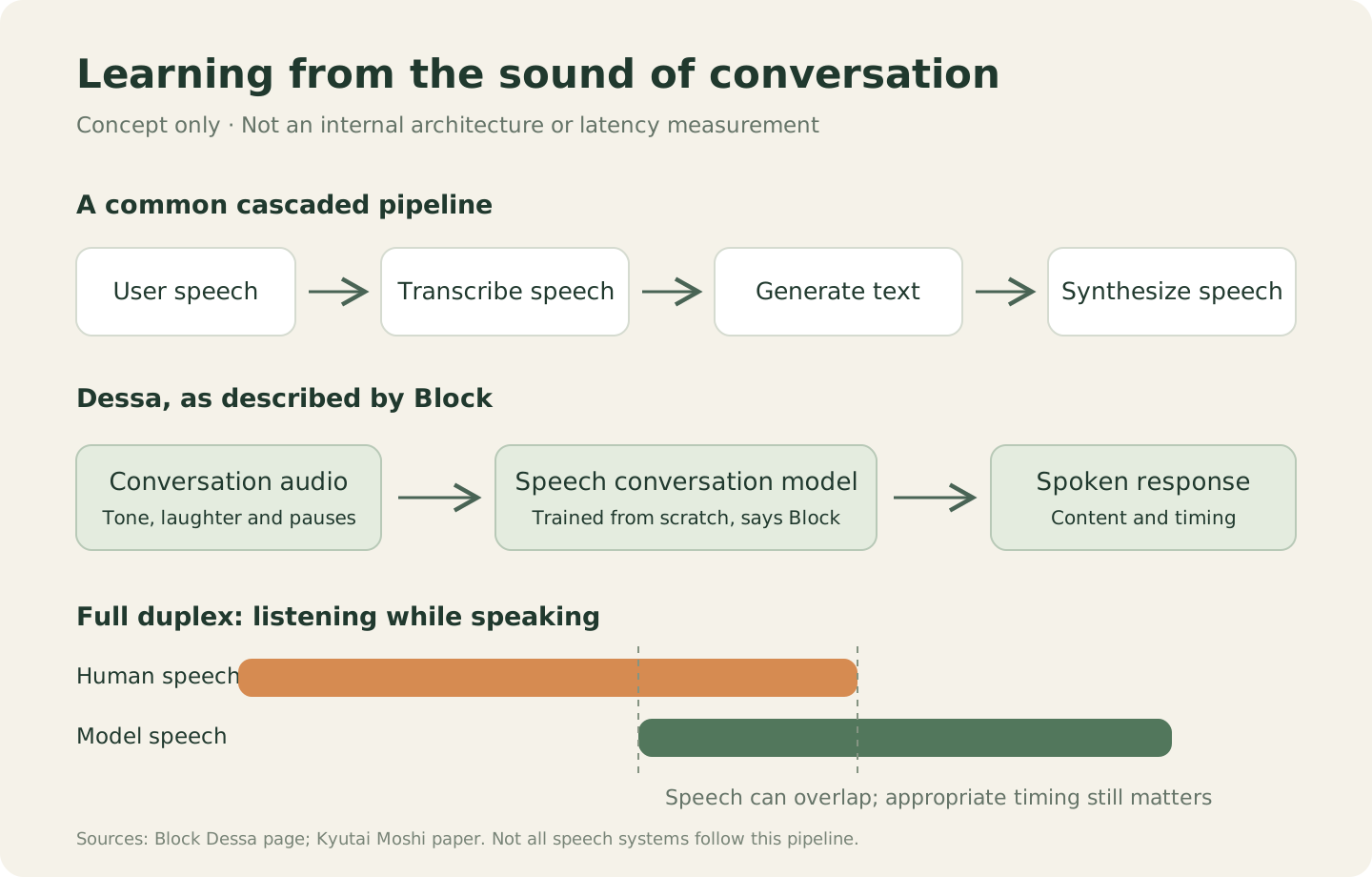
A conceptual explanation, not a disclosed internal network diagram or a latency measurement. Based on Block and the Moshi paper.
Two claims address different questions. Speech-only training concerns the starting material: Block says Dessa was trained from scratch on human conversation, without text or pretrained models. That is a developer claim, not an independently reproduced training result. Full duplex concerns interaction: the system can continue listening while it produces speech. Technical description
A common cascaded system transcribes speech, generates a text answer and synthesizes a voice. An ordinary transcript does not fully capture a sigh, a trailing vowel or a smiling denial. Those details can change meaning, which is why learning conversational audio is interesting.
Full-duplex speech research predates Dessa. Both Moshi and Hertz-dev provide earlier examples. The useful question is what Dessa's claimed training approach contributes, rather than treating it as the first AI capable of listening and speaking simultaneously.
Listeners disagree about naturalness
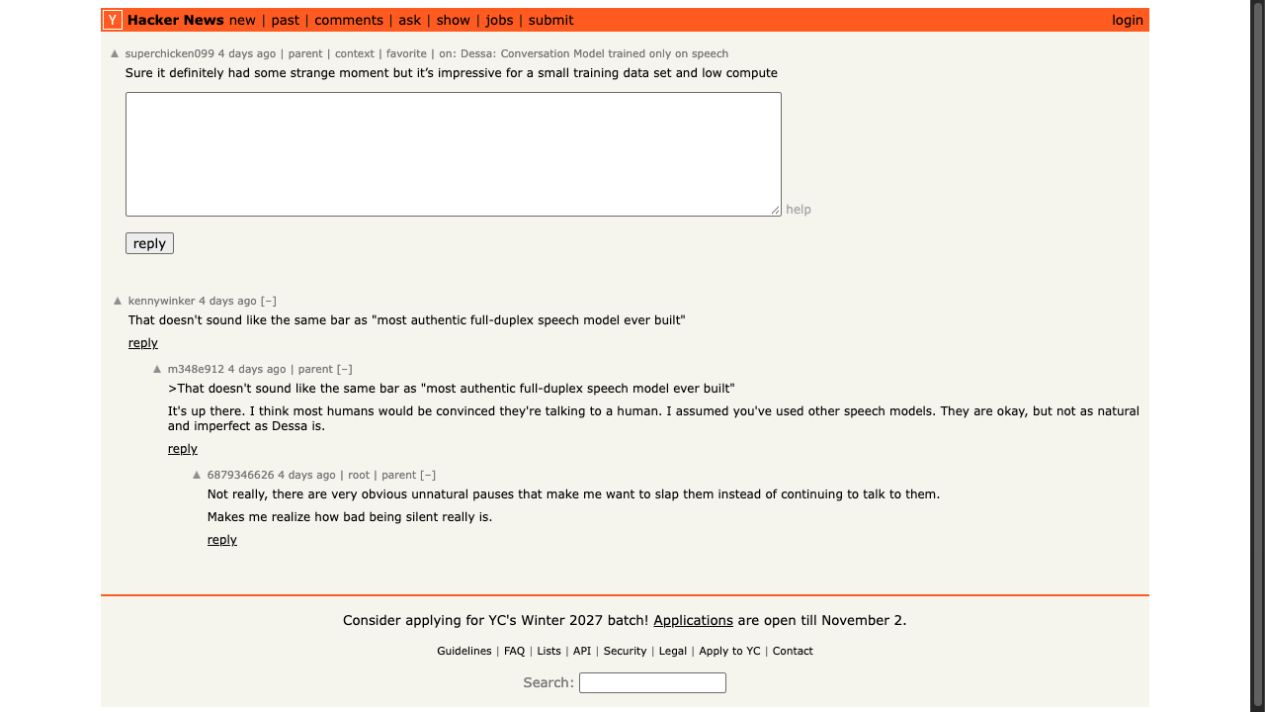
Different reactions within one discussion, not a representative survey. Original thread
In r/OpenAI, tousledmonkey noticed a sense of pride in a speaker's delivery of a son's name; lastbeer focused on phrasing and intonation. In r/accelerate, dichtbringer liked the direction but found some pauses too long and the laughter too loud. Positive details, a contrasting reaction.
Task context helps explain why those reactions matter. An interjection can signal interest in casual conversation, interrupt a learner's train of thought or get in the way of a caller explaining a problem. These comments concern selected recordings; they are not reports from a deployed product.
Local hardware does not mean a local release
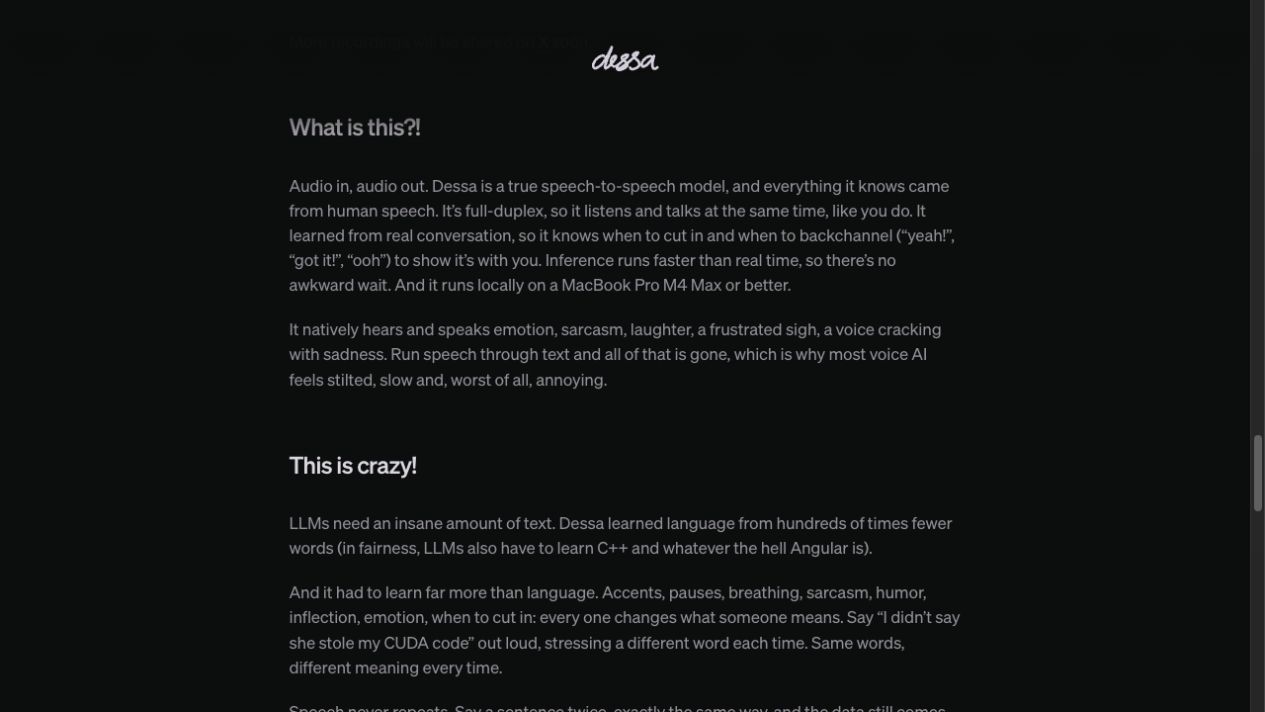
An environment described by the developer, not an installation guide. Source
Block says Dessa can run locally on a MacBook Pro M4 Max or better. It has not supplied a usable download, complete memory requirements or setup instructions. Windows, Linux and other GPU support also require documentation before anyone can offer a reliable installation walkthrough.
Training hardware is a separate matter. The team's reference to one GB200 NVL72 means a rack-scale system: NVIDIA specifies 36 Grace CPUs and 72 Blackwell GPUs. It does not mean one graphics card trained the model. Likewise, “faster than real time” is not a published end-to-end response-latency figure. Block's claim, NVIDIA specifications.
For now, the practical next step is to listen to samples that match your intended task. If your project needs production narration, language teaching or business-system access, wait for the corresponding product features, interfaces and terms before depending on Dessa.
Sources
Latest from the blog
New research, comparisons, and workflow tips from the Vibe Coding Tools team.
A recorded Muse signup through Airtap, covering email codes, birthday confirmation, Meta account creation, and the limits of the invite-code and chat checks.
A practical look at local LLMs and agent workflows on a 32GB Apple Silicon Mac mini, including Qwen3.6-35B-A3B, MLX, and tool-calling limits.
A practical review of Jev's typed decisions, state handling, current AI Gateway availability, and independent open source alternatives.