
Search Intent Lessons from Pollo, Invideo and Artlist
Search intent beyond the homepage: lessons from Pollo, Invideo and Artlist
A visitor searching for a model's brand may still choose a third-party platform. The useful question is what that platform helps the visitor finish: test a model, add a voice to an existing project, or choose the right production workflow.
This case study follows a research trail from Pollo's keyword data to a Hailuo search, then to Invideo and Artlist through ElevenLabs. It examines the connection between a query, a landing page and the next useful action. It does not establish that a particular page layout caused rankings, conversions or revenue.
Start with the evidence boundary
The supplied research notes contain a keyword-tool snapshot for August 2026, worldwide, all devices, organic search. The tool's name and raw export were not supplied. Treat the figures below as recorded third-party estimates, not verified analytics or search volume. The public product pages were checked again on September 18, 2026; their descriptions remain platform claims, not hands-on performance tests.
| Keyword | Recorded organic clicks | Associated popular page | Possible visitor task |
|---|---|---|---|
| google flow | 13.8K | /m/veo-3-fast | Find Flow or explore video generation |
| hailuo ai | 9.2K | /m/hailuo-ai | Find information about Hailuo and a way to try it |
| higgsfield ai | 7K | /hub/higgsfield-ai-review | Find a review, product details or an entry point |
| ai image editor | 5.1K | /ai-photo-editor | Edit an image |
| image to image ai | 2.6K | /image-to-image-ai | Generate a new image from an existing one |
The task column is an interpretation. A keyword alone does not tell us what every searcher intended. The recorded page associations are useful leads, but they do not establish why a visitor clicked or what happened afterward.
For site planning, the distinction between these destinations matters more than the relative size of the numbers. A review, a model page and an image editor answer different questions. A homepage cannot be assumed to serve all three equally well.
Pollo: make the model recognizable, then make the task tangible
The research notes recorded the following metadata for Pollo's Hailuo page:
| Field | Recorded value |
|---|---|
| Title | Hailuo AI Free: Try Minimax AI Video Generator Now |
| H1 | Hailuo AI Video Generator (MiniMax) |
| Description, paraphrased | An introduction to Hailuo's features and benefits, with an invitation to try it for free |
| Historical word count | 3,184, counted from rendered DOM including navigation, footer and citations; not an AITDK measurement |
That word count is neither a recommended target nor a clean measure of editorial content. The current page's title and heading still match the recorded wording, but its content can change.
The title has three jobs: identify the model, identify the activity, and offer a starting point. Each creates a corresponding check. Does the page explain the relationship between Pollo and MiniMax? Is there a working video tool? Are the limits of a free offer clear?
The saved analysis grouped the body into seven functions:
| Page element | Content in the research notes | Question it helps answer |
|---|---|---|
| Capabilities | Text and image inputs, camera control, subject references and motion | Can this handle my material? |
| Examples | Images, prompts and output videos | What might the result look like? |
| Use cases | Social content, advertising, stories, film and game art | Is my job represented? |
| Comparison | Hailuo alongside Veo and Kling | What else should I consider? |
| Getting started | Model selection, input and creation | Where do I begin? |
| FAQ | Free access, cost, resolution, customization and alternatives | What needs checking before I commit? |
| Related content | Versions, reviews and alternatives | Where can I continue researching? |
Read this as a decision sequence, not a mandatory template. A small image editor might need just an original image, an edited result, the instruction used and a clear limitation. Adding seven sections without seven real questions would only lengthen the page.
Pollo is a third-party platform in this example, not the Hailuo brand's official site. Its proposition is that a visitor can use the model through Pollo. That makes the brand keyword worth investigating; it does not prove that any third-party page can compete for it.
Use the search results to find the next comparison
The supplied notes recorded this sequence of distinct organic results for hailuo ai:
| Recorded position | Domain | Research decision |
|---|---|---|
| 1 | hailuoai.video | Official entry point |
| 2 | play.google.com | Excluded from this platform comparison |
| 3 | invideo.io | Investigate the third-party platform |
| 4 | pollo.ai | Original target; title matched the analyzed page |
| 5 | artlist.io | Retain as a comparable platform |
| 6 | litmedia.ai | Candidate for a later pass |
| 7 | easemate.ai | Candidate for a later pass |
This was one historical sample, with English and US parameters and an unconfirmed physical search location. It is not a current rank report or evidence of stable positions.
The next research question follows naturally: if several sites offer access to the same model, what useful work does each platform add around it?
Invideo: sell the finished project, not just model access
The research notes report elevenlabs among Invideo's public keywords. They identify Invideo's ElevenLabs page as relevant, but do not establish the keyword's exact traffic allocation to that URL.
Its recorded title was “ElevenLabs - Most Expressive AI Voice & Text to Speech | invideo”; the H1 was “ElevenLabs Audio.” The screenshot places the model name above a call to try it inside Invideo's agent.
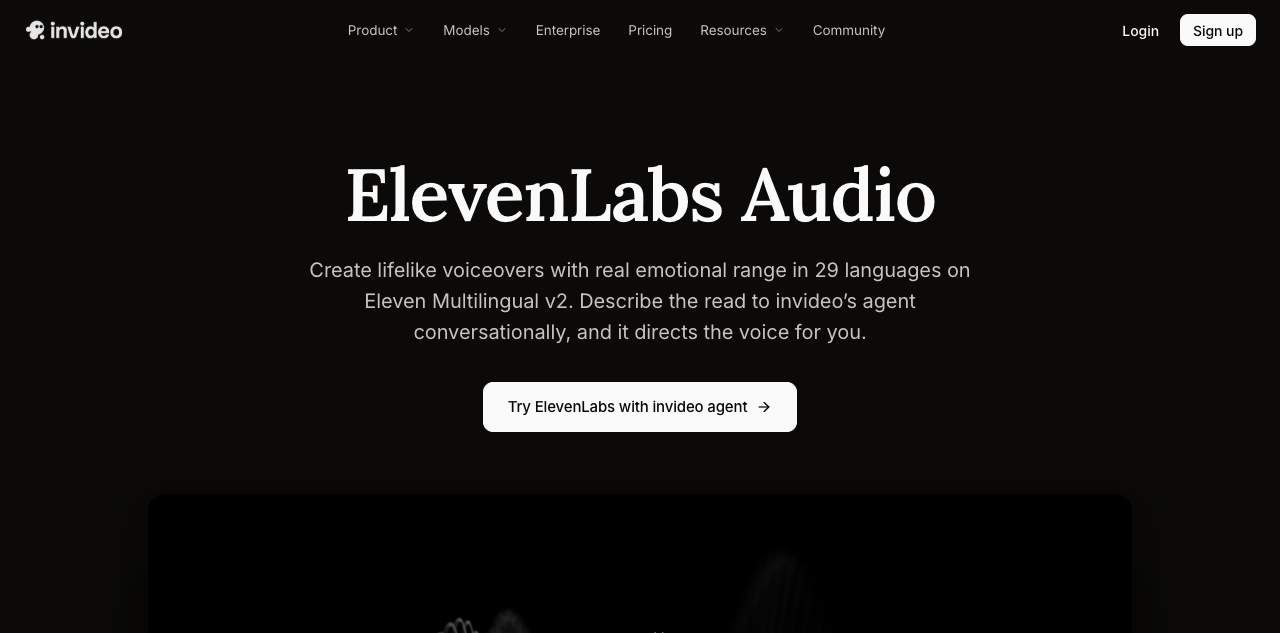
Screenshot supplied with the September 18, 2026 research notes. This is a landing-page observation, not a completed generation test.
The platform describes conversational voice direction, voices attached to project characters, a handoff into its lip-sync workflow, and user review. These are the site's value propositions; this study has not tested their reliability or account-level availability.
The editorial lesson is to explain the work saved between steps. For a hypothetical course-video product, “supports ElevenLabs” says less than a real demonstration of correcting a course term, regenerating narration and synchronizing subtitles. That demonstration belongs on the page only if the product can actually perform it.
Artlist: make the choice understandable
The notes also identify Artlist's ElevenLabs page. Artlist had already appeared in the Hailuo sample, so it was not a newly discovered domain at this point. The supplied ElevenLabs search fragment lacked both a complete result order and ad labeling; no organic position can be assigned from it.
The recorded title was “ElevenLabs: Create Lifelike AI Voiceovers | Artlist AI”; its H1 was “ElevenLabs lifelike voices in Artlist.” Its model split is more useful to this analysis than a generic promise of high-quality audio:
| Option | Page positioning | Visitor's decision |
|---|---|---|
| Eleven v3 | Expressive delivery and character voices; page body labels it Alpha | I need performed dialogue |
| Multilingual v2 | Consistent narration | I need a steady explanatory voice |
| Dubbing | Translate an existing video's speech | I already have a video to localize |
The page describes a progression from choosing a tool and supplying text or video to configuring, generating and downloading. This is a summary of its landing-page content, not a verified account walkthrough. It explicitly says Dubbing does not include lip-sync. That limit belongs near the choice, where it can prevent the wrong expectation.
The interpretation is straightforward: a model list becomes more useful when it explains which job each option serves. Invideo emphasizes project continuity; Artlist emphasizes selecting an appropriate workflow. Neither observation establishes which site converts better.
Turn the comparison into a page you can actually build
| Case | Likely task | Observed approach | Design lesson |
|---|---|---|---|
| Pollo / Hailuo | Try a video model | Capabilities, examples, comparisons and a tool entry | Help visitors judge whether the model fits |
| Invideo / ElevenLabs | Voice an existing video project | Agent direction, character voices and video workflow | Explain the useful work around the model |
| Artlist / ElevenLabs | Pick an audio workflow | Distinct options, progression and explicit limits | Help visitors choose before asking them to generate |
For a hypothetical multilingual course-dubbing service, the smallest credible page might contain:
| Area | Concrete content |
|---|---|
| First screen | Course-video translation purpose, upload entry and format limits |
| Example | Original and translated audio from the same short lesson, with subtitles |
| Choice | Separate new narration from translation of an existing video |
| Process | Upload, select language, review and edit, export |
| Added value | A working demonstration of terminology correction or subtitle synchronization |
| FAQ | File limits, billing, retention and whether lip-sync is included |
These are design suggestions, not claims that such a product already exists or that the three platforms offer every item.
Before publishing your own page, check five things: the visitor can recognize the task, examples support the promise, the entry point delivers what is described, important choices and limits are visible, and the next action is clear. If a capability is missing, narrow the promise before expanding the copy.
Then measure the hypothesis. Use first-party query and landing-page data to see who arrives, and product events to see whether they start and complete the intended task. The case study offers a way to decide what to test; it supplies no conversion baseline and no causal SEO result.
Latest from the blog
New research, comparisons, and workflow tips from the Vibe Coding Tools team.
Use Similarweb, Google Trends, competitor traffic, and a KGR example to assess an audio-to-SRT tool opportunity.
Install Taste Skill for Claude Code, Codex, or Cursor. Explore real website examples, copy practical prompts, and read community feedback.
A practical way to turn rising Vercel subdomains into testable demand leads using landing-page trends, keyword mix, backlinks, and Google Trends.