
DeepInfer Explained: What DeepSeek's Inference Framework Means for Everyday Users

An AI-generated concept illustration from the source draft, not a deployment diagram.
DeepInfer is infrastructure for running AI models. For everyday users, its potential value arrives through the services built on top of it: providers may use hardware more efficiently and improve response times or costs. Whether that becomes a better product or a lower bill depends on adoption.
DeepInfer through a restaurant analogy
Think of a trained DeepSeek model as the chef: it supplies the learned capabilities behind answers, translations and code. The inference framework is the kitchen's working system, organizing computation so that the chef's skills can be used efficiently.
The official repository provides offline inference. A complete online service still needs additional cache infrastructure, disaggregated serving components and load balancing.
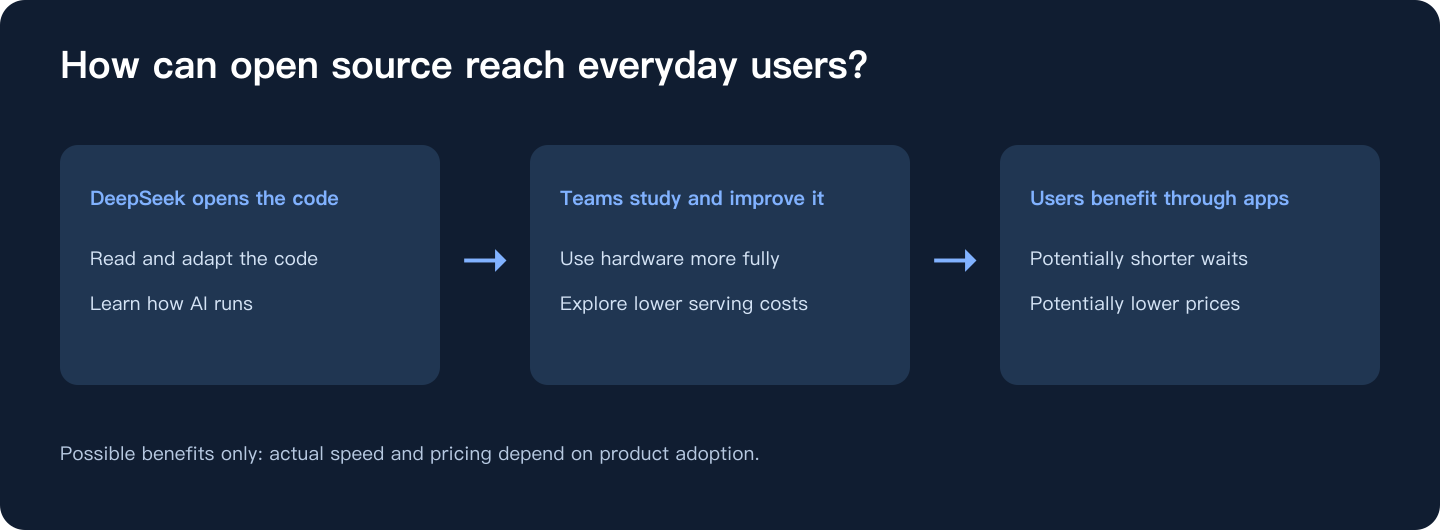
This shows a possible path to benefits, not measured speedups or price reductions.
Where users might notice a difference
- Batch writing and translation: a service processing hundreds of documents could explore better use of its inference hardware. Evaluate the whole job's cost, quality and completion time.
- Coding assistants: repeated model requests can make inference latency matter across a longer task. Correct code still depends on the model, tools and validation.
- Company-hosted AI: teams running document or support workflows on their own infrastructure can study DeepInfer and its integration requirements.
These are use-case suggestions, not deployments tested for this article. The official hardware list names NVIDIA SM100 GPUs and Huawei Ascend 950 NPUs; this is specialist infrastructure, rather than a consumer laptop installation guide. Supported hardware and release scope
What the DeepInfer community is doing
Learning the implementation. DeepInfer Explained combines explanations, diagrams and code references. It offers an accessible way to study request execution without owning a serving cluster.
Exploring additional hardware. DarkraiHL's pull request #92 describes running DeepSeek-V4.1-Flash on four or eight H20-3e GPUs. At the November 11 check, the proposal remained open. Those are the contributor's results, not an expansion of the official support list.
Documenting deployment experiments. An Alibaba Cloud community article describes work using four B200 GPUs and changes to data handling. Treat it as the author's deployment exploration; check its environment and image notes before following it. We did not reproduce the experiment.
What to do next
If you mainly use AI to write, translate or organize information, choose products by the work they complete, their quality and their price. You do not have to manage the underlying inference framework yourself.
If you build applications, watch for concrete service improvements rather than assuming open source will automatically change pricing. Infrastructure teams can start with the official release scope and community experiments, then test their own environment.
For learners, the interactive explainer is a practical starting point: understand how a question becomes an answer before diving into the engine.
Sources checked November 11, 2026. No deployment or performance benchmark was run for this article.
Latest from the blog
New research, comparisons, and workflow tips from the Vibe Coding Tools team.
Learn agent harness engineering with a curated beginner-to-advanced list of official tutorials, videos and repositories covering tools, context, permissions and evals.
Understand deepseek-v4-pro-qwen3.5-9b-uncensored-heretic: Qwen weights, claimed DeepSeek teacher data, ARA layers 9–23, and evaluation limits.
Follow a real DeepSeek Superagent task through five screenshots: submit a request, inspect routing, watch a Worker create a file, and learn when its session is reused.