
How to Turn App Reviews into a Website Opportunity
How to Turn App Reviews into a Website Opportunity
The useful business signal in an app review is rarely the requested feature. It is the cost a user keeps absorbing while trying to finish a job.
Researching PhotoRoom and Pixelcut led to one testable proposition: an AI product-photo service for small shops and resellers where customers preview the output first and pay only for images they accept. Broken generations, distorted products, and unwanted people would not consume the customer's deliverable allowance.
That idea did not come from copying a competitor or treating one angry review as market research. It emerged through four different evidence layers—and each layer could prove only part of the case.
Evidence layer 1: Is money already changing hands?
The investigation began with PhotoRoom's Sensor Tower overview. A screenshot observed on August 28, 2026 showed roughly 700K worldwide downloads and about $2M in store revenue for the previous month.
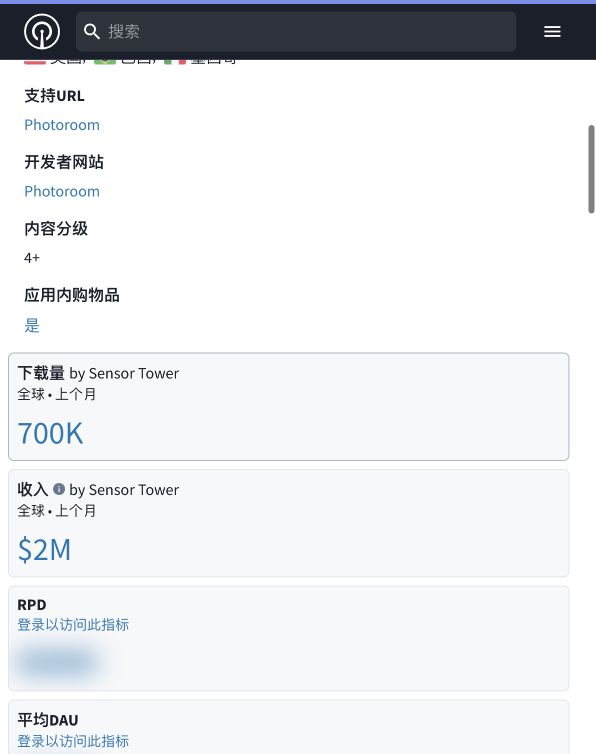
These figures are a filter, not a forecast. Sensor Tower describes downloads and revenue as estimates; they are not audited profit, and they do not capture every possible web, advertising, or enterprise payment. They show that people download this kind of product and that app-store spending exists. They do not show what a new entrant will earn.
That distinction prevents an attractive dashboard from becoming a false business case.
Evidence layer 2: What outcome is the buyer hiring the app for?
A positive review on the PhotoRoom App Store page supplied the missing context. The reviewer was a reseller listing products on marketplaces such as eBay, Depop, and Mercari. Editing was not her craft; it was extra work standing between a phone photo and a live listing.

She was not buying background-removal technology for its own sake. She was buying a faster route to a professional-looking listing.
That changes the market description from “people who edit images” to “small sellers who repeatedly need marketplace-ready product photos without becoming designers.” The latter has a user, a recurring job, and a measurable finish line.
Evidence layer 3: What can one bad review tell us?
Another PhotoRoom App Store reviewer described automatic removal cutting too deeply into the subject and wanted better masking or feathering controls.
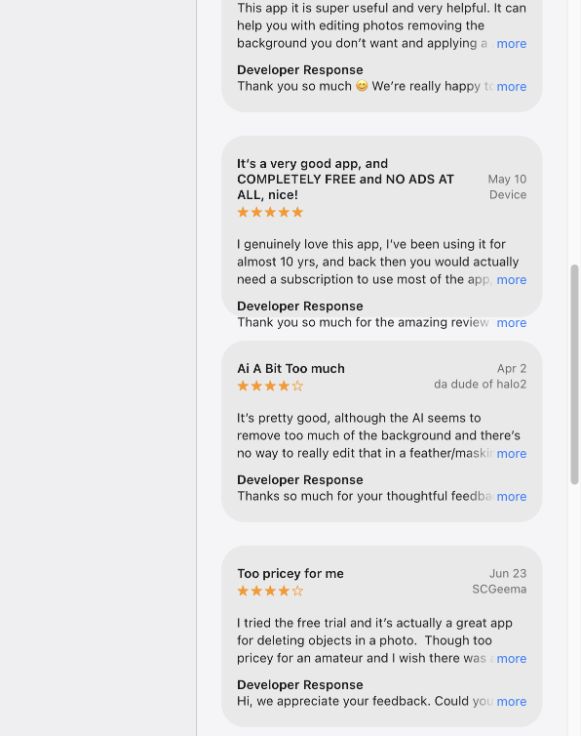
This is useful, but only as a search lead. One review cannot establish frequency, current product behavior, or willingness to switch. Building a specialist cutout editor at this point would still be guesswork.
The better question is not “Which feature is missing?” but “What does the failure cost this user?” The answer needs repeated evidence.
Evidence layer 4: Does the loss repeat across users?
On the observation date, PhotoRoom's Trustpilot profile displayed 250 reviews. Its automated summary, based on 127 recent reviews, surfaced complaints involving subscription changes, limits, additional payments, errors, and support.
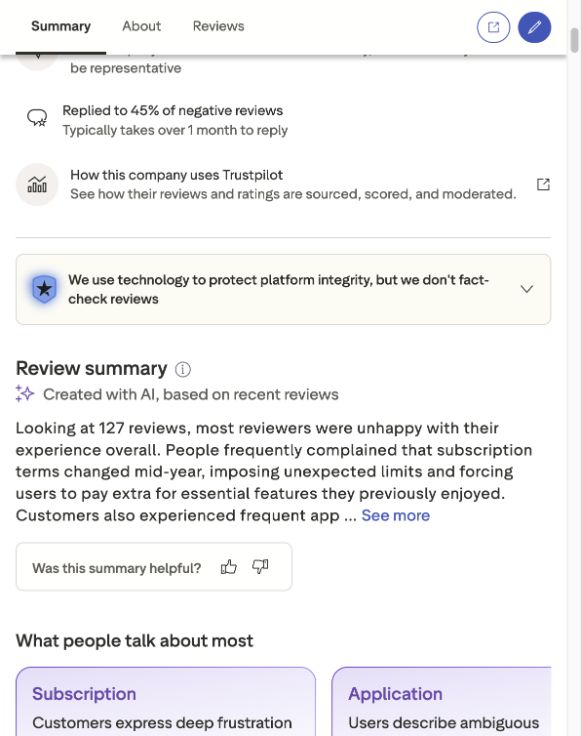
An automated summary is navigation, not proof. Reading the PhotoRoom reviews filtered for credits exposed the mechanism behind the frustration: unused credits expiring, reset schedules changing, failed exports still consuming credits, and users spending attempts on unusable AI output.
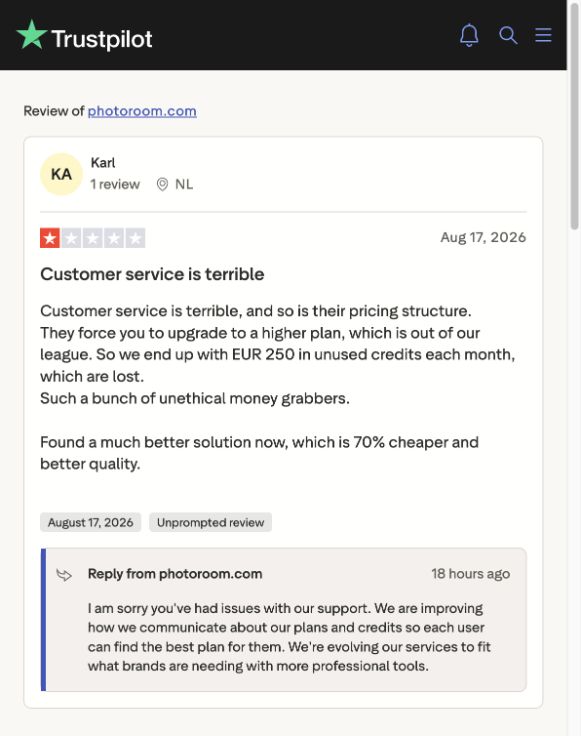
The decisive detail was not that generation sometimes fails. Every generative product fails. It was that the user could pay for each failure while searching for one usable result.
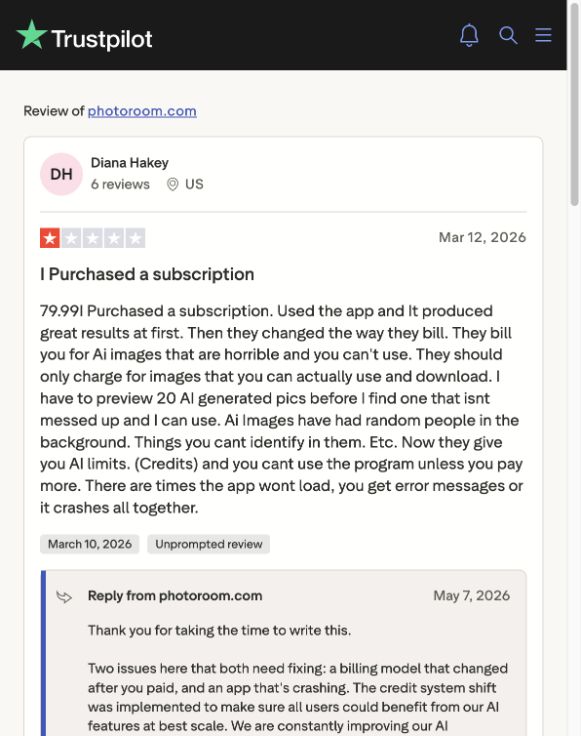
This makes the visible package price a poor description of the customer's real cost. If one accepted image requires an unpredictable number of attempts, the cost per finished listing is unpredictable too.
Cross-product validation: Is this only a PhotoRoom issue?
To separate a product-specific complaint from a category-level opening, the same search was repeated with Pixelcut.
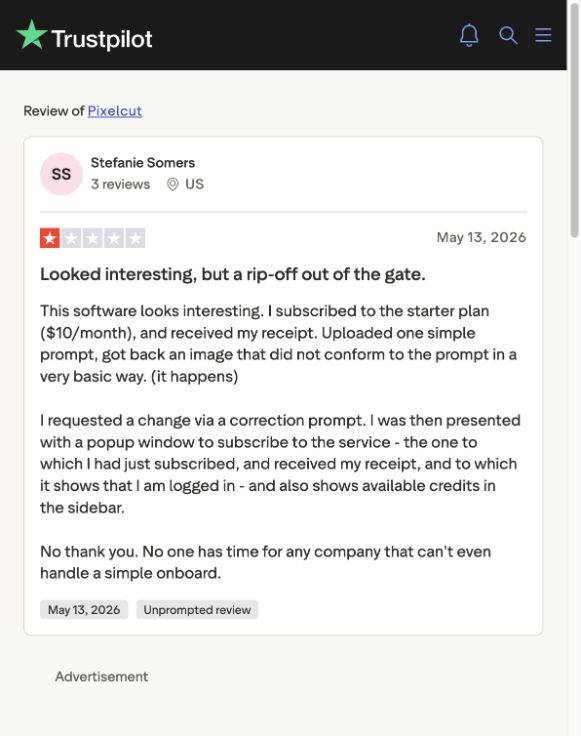
Pixelcut Trustpilot reviews mentioning credits included individual reports of prompts not being followed, revisions consuming more allowance, repeated attempts producing no acceptable image, and unclear credit consumption.
On the Pixelcut App Store review page, another reviewer described unwanted people appearing in AI backgrounds and the retries required to remove them.
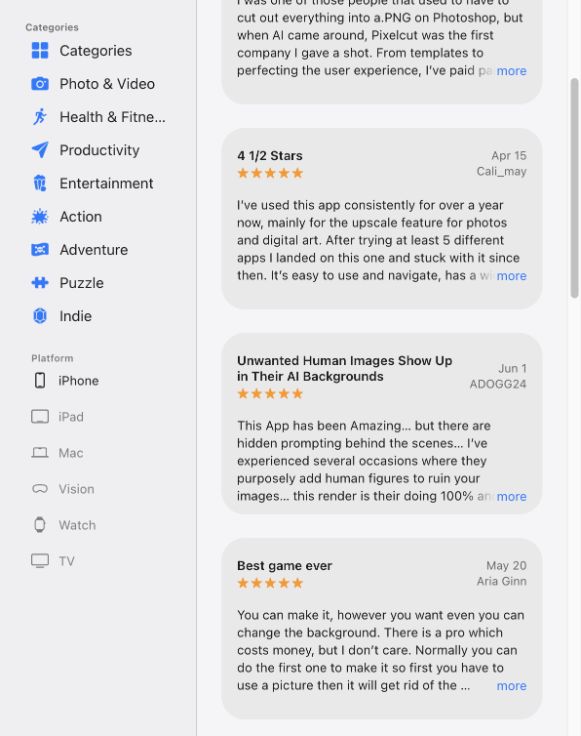
Now the pattern crossed two products and two review sources. That still does not quantify a market, but it is enough to justify a small demand test: users may value predictable cost per usable image more than another bundle of generation credits.
The opportunity is a different risk contract
The shared user journey looks like this:
Seller needs a product image
→ buys an AI image plan
→ receives distorted or irrelevant output
→ retries until one image is usable
→ every attempt consumes credits
→ final cost per listing is unknown
“Cheaper credits” treats the symptom. The deeper job is: “Let me pay a known price for a product photo I can actually publish, and do not charge me for the model's mistakes.”
That is a pricing and trust innovation, not merely an image-generation feature.
A minimum website worth testing
The first version can be deliberately narrow:
- Upload one or several product photos.
- Choose a white background or a small set of fixed scenes.
- Generate watermarked previews.
- Retry visibly broken results without consuming deliverable credits.
- Pay for and download only the selected images in marketplace-ready sizes.
The landing-page promise could be equally narrow: AI product photos—pay when you accept the result. Failed or distorted images do not count.
There is no need for a full editor, video generation, a template community, collaboration, Shopify administration, or dozens of models in the validation product. The service also should not promise flawless AI. Its defensible promise is that customers do not bear the billing risk when AI is wrong.
A reusable review-research checklist
Use this sequence for another app category:
- Confirm visible download and payment activity, while labeling estimates correctly.
- Read positive reviews to identify the buyer's recurring job and desired result.
- Treat each negative review as a hypothesis, not a verdict.
- Search original reviews for repeated loss: money, time, failed work, or uncertainty.
- Repeat the search on another product and another source.
- Convert the repeated loss into a promise that can be tested on a landing page.
- Build only the shortest workflow needed to test payment intent.
Pages and figures in this article were observed on 2026-08-28. Sensor Tower figures are third-party estimates. Trustpilot's automated summary was used only to locate themes. Reviews are personal user statements and demand signals, not factual rulings about company policy, fault, or wrongdoing.
Latest from the blog
New research, comparisons, and workflow tips from the Vibe Coding Tools team.
A recorded Muse signup through Airtap, covering email codes, birthday confirmation, Meta account creation, and the limits of the invite-code and chat checks.
A practical look at local LLMs and agent workflows on a 32GB Apple Silicon Mac mini, including Qwen3.6-35B-A3B, MLX, and tool-calling limits.
A practical review of Jev's typed decisions, state handling, current AI Gateway availability, and independent open source alternatives.